How to Read All Sidewall Markings
What does the size code actually mean?
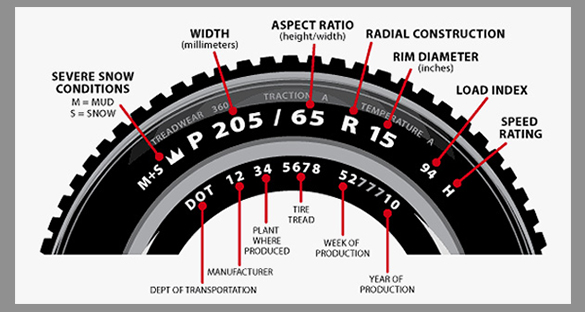
The first block you see — something like P215/65R15 — breaks down into four pieces. The letter at the front (P) means passenger vehicle. You might also see LT for light truck or no letter at all for European metric. The three-digit number (215) is the section width in millimeters, measured from sidewall to sidewall when the tire sits on its proper rim. The two-digit number after the slash (65) is the aspect ratio — the sidewall height as a percentage of the width. So 65 means the sidewall is 65 percent of 215 millimeters, roughly 140 millimeters tall. The letter after that (R) stands for radial construction, which is what almost every modern tire uses. The last number (15) is the wheel diameter in inches. That tire fits a 15-inch rim. Think of it like a shoe size: width, how tall the side is, how it's built, and what wheel it hugs. If you swap to a different width or aspect ratio, your speedometer reads wrong and the tire can rub the fender or suspension. Stick to what the door placard says.How do load index and speed rating work together?
Right after the size, you'll see two characters like 95H. The number (95) is the load index — a code for how much weight that tire can carry at its maximum inflation. A 95 equals 1,521 pounds per tire. The letter (H) is the speed rating — the maximum sustained speed the tire is tested for. H means 130 mph. You'll see S (112 mph), T (118 mph), V (149 mph), W (168 mph), Y (186 mph), and others. The rating is tested in a lab under load, not a suggestion for how fast to drive on I-95. Here's the catch: load index and speed rating are paired. A tire rated 95H can carry 1,521 pounds at speeds up to 130 mph. If you run it at 95V, it carries the same weight but handles higher speed — usually with a stiffer sidewall and different tread compound. Never go lower than the placard's load index. Going higher is fine. Speed rating can be higher, but never lower.Where do I find the manufacture date and why does it matter?
Look for the letters DOT followed by a string of numbers and letters. The last four digits are the date code. The first two are the week of the year (01 through 52). The last two are the year. So 2319 means the 23rd week of 2019. A tire built in week 40 of 2020 reads 4020. Tires age even sitting on a shelf. Rubber dries out, cracks form, and the internal belts can separate. Most shops and manufacturers recommend replacement at six years from the build date, ten years absolute max — regardless of tread depth. In South Florida heat and humidity, that clock ticks faster. UV, salt air, and 95-degree pavement age a tire quicker than a garage in Ohio. If you're buying used tires, check that code before you hand over cash. A tire with 90 percent tread but a 2016 date code is a risk. You can't see the internal damage.What about the UTQG ratings molded into the sidewall?
UTQG stands for Uniform Tire Quality Grading — a government-mandated system. You'll see three markings: treadwear, traction, and temperature. Treadwear is a number like 400, 500, 600. Higher means longer-wearing in the test, but the test is done on a specific government track in Texas. A 600 doesn't mean 60,000 miles. It means it wore half as fast as the control tire rated 100. Real life — potholes on NE 2nd Avenue, hard braking at the 125th Street light, salt spray — changes everything. Traction gets a letter: AA, A, B, or C. AA is best wet braking on asphalt and concrete. Temperature gets A, B, or C — resistance to heat buildup at speed. A is best. Every tire sold in the U.S. must meet at least C for temperature. These grades help compare tires in the same category, but they don't tell you how a tire feels in a Florida downpour.What does the max pressure marking tell me?
You'll see "MAX PRESS 44 PSI" or "300 kPa" molded near the bead. That is the absolute maximum cold inflation pressure the tire structure can handle — not the pressure you should run. The right pressure for your car is on the placard inside the driver's door jamb (or glove box, or fuel door). For most sedans, that's 32 to 35 PSI cold. Running at the sidewall max gives a harsh ride, uneven wear in the center, and less grip. Running low builds heat, kills fuel economy, and can blow the sidewall out on a hot July run to Fort Lauderdale. Check pressure when tires are cold — first thing in the morning, before you drive more than a mile. Heat from driving adds 4 to 6 PSI. That's normal. Don't bleed it off.What are the other markings I might see?
You'll spot M+S or M/S — mud and snow. It means the tread pattern meets a minimum void ratio for loose surfaces. It doesn't mean it's a true winter tire. For that, look for the three-peak mountain snowflake symbol (3PMSF). You might see "TUBELESS" or "TL" — no inner tube needed. "STEEL BELTED" or "RADIAL" repeats the construction. Some tires show a rotation arrow — directional tires must spin one way. Asymmetric tires show "OUTSIDE" on one sidewall. Mount them wrong and you lose wet traction and wear them fast. There's also a mold number, plant code, and sometimes a yellow or red dot near the bead. Those are for the installer — the dots mark the tire's light and heavy spots so the tech can balance it properly. You don't need to decode them, but now you know they're not random stamps.The video below, "The Ultimate Guide To Tire Sidewalls" from Engineering Explained, walks through every marking on a real tire — size, load index, speed rating, DOT date, treadwear, traction, and temperature grades — with clear visuals for each one. If any section above felt dense, watching it on an actual sidewall makes it click.
Engineering Explained goes through the full sidewall code on camera: what 235/35R20 means, what ZR signifies, how treadwear ratings and temperature grades work, and what the load rating, speed rating, and DOT badge tell you. It's the visual companion to everything above — pause it next to your own tire and read along.
When to call us
If the sidewall shows a date code older than six years, a load index below your door placard, cracks, bulges, or a max-pressure stamp you're unsure about — call North Miami Tire at (786) 949-9563. We serve North Miami and nearby, Monday through Friday 5 PM to 7 AM, Saturday and Sunday 24 hours. We'll read your sidewalls with you, check the date codes on all four, and tell you straight which tires are fine and which ones are done. No pressure, no upsells.