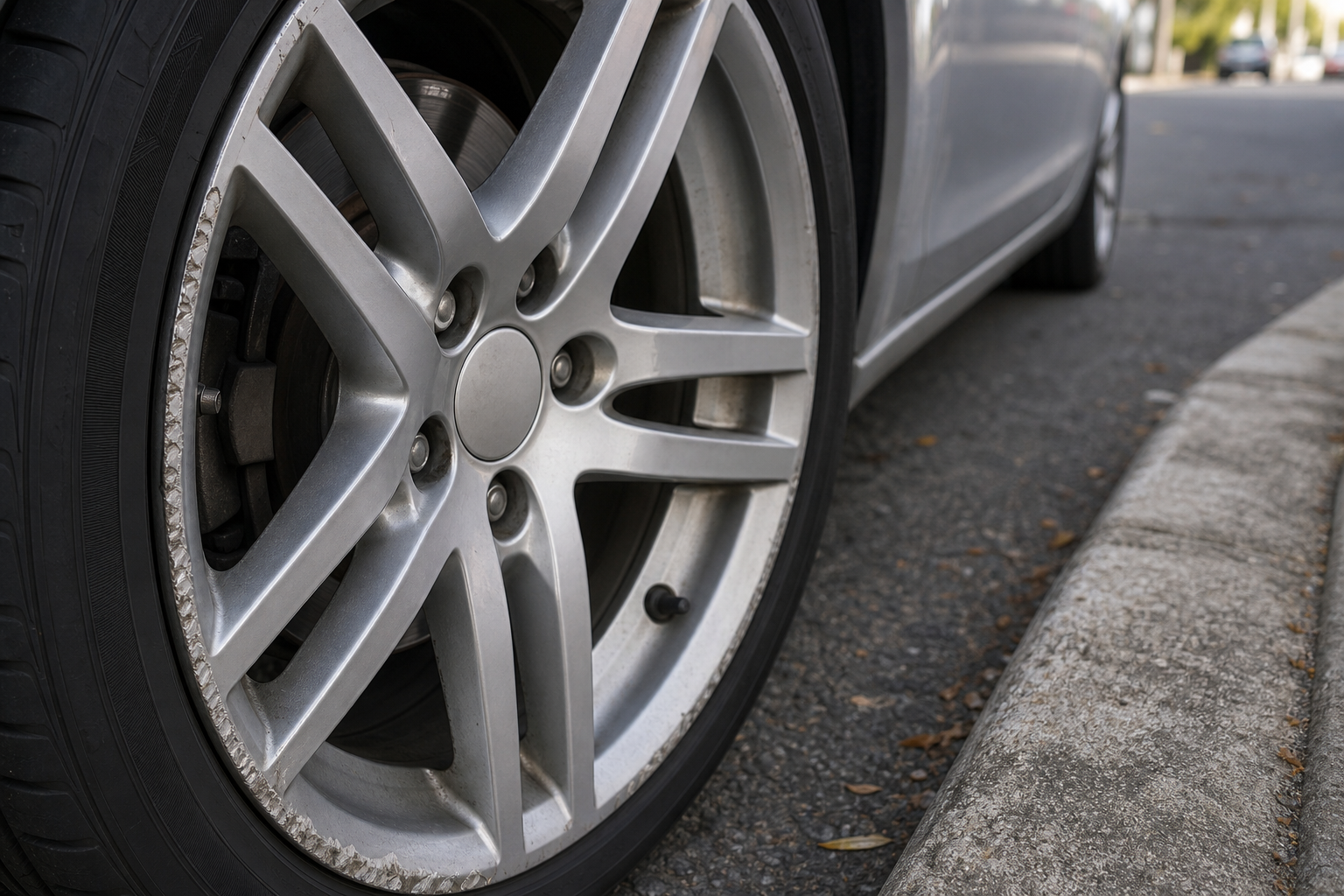
Curb Rash: Cosmetic vs. Structural
Curb rash is cosmetic when the damage stays in the clear coat or paint layer — scratches, scuffs, and shallow gouges you can feel with a fingernail but that don't reach the base metal. It becomes structural when the impact cracks or bends the wheel's load-bearing metal, especially at the bead seat where the tire seals or the spoke roots where the wheel handles cornering forces. A cosmetic mark needs refinishing; a structural crack means the wheel must be replaced.
What is curb rash exactly?
Curb rash is the catch-all term for any damage a wheel takes from rubbing or hitting a concrete curb. The wheel's outer lip — the flange that sticks out past the tire sidewall — takes the hit first. On most modern alloy wheels, that lip is painted or clear-coated over bare aluminum. A light kiss scrapes the finish. A harder hit digs into the metal itself. The tire sidewall flexes some, but once the rubber compresses fully, the rim meets concrete directly. That's when metal moves.How can you tell cosmetic from structural damage?
Run your fingernail across the mark at a 90-degree angle. If your nail catches a ridge but slides over it without dropping into a gap, the damage is likely confined to the finish layer. Cosmetic rash looks like white or gray streaks where the clear coat tore away, sometimes with aluminum showing bright underneath. You might see parallel lines from the curb's rough aggregate — like someone dragged a comb through wet paint. Structural damage shows differently. Look for a line that interrupts the wheel's roundness — a flat spot on the lip where the curve should be. Shine a phone flashlight along the bead seat, the flat inner shelf where the tire bead sits. A hairline crack there often appears as a dark thread that doesn't wipe away. Tap the wheel gently with a metal wrench handle; a cracked rim gives a dull *thud* instead of a clear *ring*. The difference is the same as tapping a solid dinner plate versus one with a hairline fracture — one sings, the other thuds. Think of the wheel like a bicycle wheel. The rim is the hoop, the spokes are the arms connecting to the hub. Cosmetic rash is paint scraped off the hoop. Structural damage is a bent hoop or a cracked spoke root. The hoop carries the tire's air pressure and the vehicle's weight. The spokes handle side loads when you turn. If either yields, the wheel can't do its job.Why does the difference matter for safety?
A cosmetic gouge won't make the wheel fail. It exposes bare aluminum to salt air and brake dust, which accelerates corrosion, but the metal underneath remains intact. You can drive on it for months — though the corrosion will spread under the clear coat like rust under a car's paint bubble. A structural crack changes everything. The wheel spins at 800 revolutions per mile at 60 mph. Each revolution loads and unloads the crack tip. Aluminum doesn't have a fatigue limit like steel — every stress cycle grows the crack a microscopic amount. A crack at the bead seat lets air escape slowly, then suddenly when the tire bead unseats. A crack at a spoke root can let the center section separate from the rim under a hard corner. Neither gives warning before it lets go.What does a structural crack look like up close?
Clean the area with brake cleaner and a shop rag. Dry it. Spray a light coat of foot powder or dry shampoo — the white powder settles into cracks and makes them visible. A structural crack shows as a clean, sharp line through the powder, often branching like a lightning bolt. Cosmetic scratches look like fuzzy scratches in the powder; they don't penetrate the metal grain. Another test: flex the wheel slightly. Jack that corner, support the car on a stand, and push/pull the tire sidewall at 3 and 9 o'clock. Watch the suspect area. A crack will open and close — you'll see the powder line widen and narrow. Cosmetic damage won't move. This is the same principle a welder uses to find cracks in a frame: stress reveals what eyes miss.Can you drive on cosmetic curb rash?
Yes, but treat it like a scratch on your phone screen — it spreads if ignored. Salt air on Collins Avenue or the Intracoastal accelerates aluminum oxidation. The exposed metal turns chalky white, then pits. Once pitting starts, the clear coat won't adhere properly during refinishing. Sand the gouge with 320-grit, wipe with alcohol, and hit it with a rattle-can clear coat matched to your wheel finish. It's not perfect, but it seals the metal. Plan a proper refinish within a year.What about the bead seat area?
The bead seat is the most critical sealing surface on the wheel. It's the narrow flat band where the tire's steel bead wires sit under 30-35 PSI. A scratch here that you can feel with a fingernail *across* the seating direction (circumferential) can leak. A scratch *along* the seating direction (radial) usually seals fine. A crack anywhere on the bead seat — even a hairline — will leak. No sealant, no bead sealer, no amount of air pressure fixes a cracked bead seat. The wheel is done. Think of it like a mason jar lid. A scratch on the glass threads might still seal. A crack in the glass threads never will. The pressure pushes the crack open every time the tire heats up on I-95.The video below is a DIY guide to repairing wheels with curb rash and scratches, walking through the repair steps.
When to call us
DIY is great, but some jobs need a pro. If the problem persists, you spot anything dangerous, or you'd rather have an expert handle it, call (786) 949-9563 — North Miami Tire serves North Miami and nearby (Mon-Fri 5PM-7AM, Sat-Sun 24H). No pressure, no upsells.