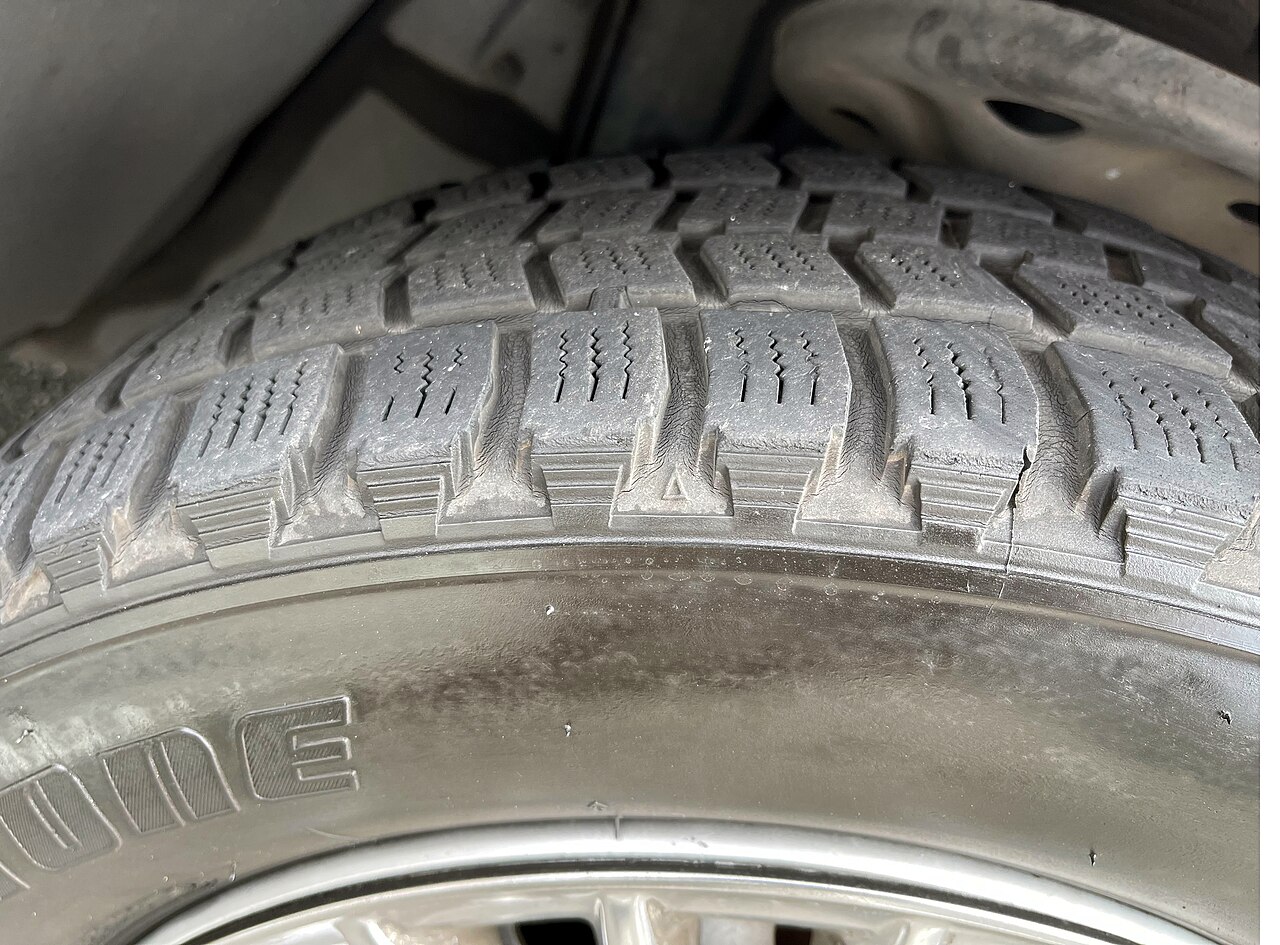
Tread Wear Bars: Built-In Indicators
What are tread wear bars and where do you find them?
Every passenger tire sold in the United States has them. Manufacturers mold six or more of these indicators around the circumference, spaced evenly inside the deepest circumferential grooves. They're not added later — they're part of the original mold. Each bar sits about 2/32 inch above the groove floor. When new, you can't see them because the tread blocks tower over them. As rubber wears away, the bars emerge. You'll spot them by looking straight down into the grooves, not from the side. A flashlight helps in the shade. On a typical all-season tire, the bars run perpendicular to the direction of travel, looking like little speed bumps across the channel. Some tires also put small triangle markers on the sidewall shoulder to help you locate the groove that holds the bars.Why does 2/32 inch matter in Florida?
Florida law follows the federal minimum: 2/32 inch of tread depth on any major groove. Below that, the tire is legally bald. But the real issue shows up in a South Florida downpour. At 2/32 inch, a tire can't move water out from under the contact patch fast enough. Hydroplaning risk jumps sharply. I've seen cars slide across the Turnpike entrance ramp near Golden Glades because the driver thought "a little tread left" was good enough. It wasn't. The bars exist because most people don't carry a tread depth gauge. They don't need to. The bar is the gauge. When you can lay a penny flat across the tread and Lincoln's head disappears, you're above 2/32. When the bar is level with the block, you're at or below it. No guessing.How can you check wear bars yourself in two minutes?
Park on level ground. Turn the steering wheel to one side so the front tires angle outward — this opens the outer grooves for a clear view. Grab a flashlight or use your phone light. Look into each main groove around the whole tire. You're checking for two things: any bar that's flush with the tread blocks, and any spot where the bar is higher on one side than the other (that's uneven wear, a different problem). Run your fingertip across the groove floor. You'll feel the bar before you see it clearly. If your finger slides from block to bar with no step down, that tire is at the limit. Check all four tires. The rears often wear differently than the fronts, especially if you haven't rotated them every 5,000 to 7,500 miles.What don't the bars tell you?
The bars only measure depth at that one groove. They won't show dry rot cracking, a nail hiding in the inner shoulder, or a belt separating into a sidewall bulge — I've pulled a tire that passed the bar test with a quarter-inch bubble from a pothole on NW 7th Avenue. The bar said legal. The bubble said dangerous. They also don't account for age. Rubber hardens over time. A six-year-old tire with 6/32 inch left can grip like a hockey puck on wet pavement. The DOT date code on the sidewall — four digits, week and year — tells you the birth date. Most shops recommend replacement at six years regardless of tread.When the wear bars tell you a tire is done, your next move is buying the right replacement — and that starts with the size code stamped on your sidewall.
Seeing the wear bars in person removes all doubt — this DIY tutorial from an independent garage channel shows where the bars live in the tread grooves and how to measure tread depth with a cheap gauge.
The video comes from the independent DIY channel 4DIYers and covers exactly what this article is about: how to measure tire tread depth and read the wear indicators. He shows how to find the wear bars by looking for the small arrows molded into the tire's shoulder, which mark where the bars sit in the tread grooves — raised rubber strips that reveal how much usable tread is left. He then demonstrates an inexpensive plunger-style tread depth gauge: push the plunger down beside a wear bar, seat the gauge flat on the tread face, and read the depth in 32nds of an inch or millimeters. He takes real measurements on a nearly new tire and on a set of winter tires, compares readings across the tread face, and explains how uneven numbers point to alignment or suspension issues. He also shows a caliper's depth function as an alternative tool. Simple, visual, and matched to the check you're doing in your driveway.
What does uneven wear tell you?
If the bar on the inside groove is flush but the outside groove still has 4/32 inch, your alignment is off. Camber wear, toe wear, or a worn suspension bushing will eat one shoulder faster. The bar on the bad side hits the limit first. Replacing just that tire without fixing the alignment burns the new one in a few thousand miles. Cupping — scalloped dips around the tread — makes the bars look wavy, some high, some low: usually worn shocks or struts. Feathering — one side of each tread block rounded, the other sharp — points to toe misalignment. The bars don't diagnose these, but they highlight where the rubber went missing, and that pattern tells the story.Can wear bars lie to you?
On a retreaded tire, the bars are molded into the new cap rubber. They're accurate for the cap, but they don't know if the casing underneath has fatigue cracks. Commercial trucks use retreads daily. Passenger cars rarely should. If you're buying used tires — something I don't recommend — the bars only tell you how much cap is left, not how old the casing is. A deep cut or a chunked tread block wears faster than the rest of the tire. The bar in that groove can hit flush while the neighboring groove still has depth. That tire is done — the weak spot fails first, usually at highway speed.Why does mobile service change the math?
You find the bars flush at 6 p.m. on a Tuesday. The tire shops on Biscayne close at 7. You're in pajamas, dinner's on the stove, and you don't have a spare with air in it. That's when you call us. We bring the tire, the tools, and the torque wrench to your driveway in North Miami, Aventura, or Miami Gardens. No tow truck. No waiting room. You stay home. We swap it in your parking spot.What do drivers usually ask about tread wear bars?
Are the wear bars the same thing as the penny test?
They measure the same limit — 2/32 inch — but they aren't the same tool. The wear bar is built into the tire and tells you depth only at its one groove. The penny test lets you probe any spot on any groove, which matters when wear is uneven: one groove can be at the limit while its neighbor has twice the rubber left. Use the bars for the quick glance, the penny for the full check. If either says 2/32, believe it.
Can I drive a little longer once a bar is flush?
No — flush is the legal end of the line in Florida, not an early warning. Below 2/32 inch, the tread can't evacuate water fast enough, and hydroplaning on a rain-soaked Turnpike happens in seconds, not miles. If money is tight, one replacement tire on the worst corner today beats four balding ones through the next downpour. The bar is the tire's last honest word.
How often should I actually check the bars?
Once a month is plenty for a daily driver, plus a look before any road trip up I-95 or down to the Keys. Tires lose roughly 1/32 inch every 10,000 to 15,000 miles on a properly aligned car, so monthly glances catch the trend long before it becomes a surprise. Make it part of the same walk-around as your pressure check.
When to call us
DIY is great, but some jobs need a pro. If the problem persists, you spot anything dangerous, or you'd rather have an expert handle it, call (786) 949-9563 — North Miami Tire serves North Miami and nearby (Mon-Fri 5PM-7AM, Sat-Sun 24H). No pressure, no upsells. One honest limit: if the issue is alignment-only — the tires are fine but the car pulls — that's a shop-with-a-rack job, not a driveway job, and we'll tell you so.