How to Use a Gas Station Air Pump
A gas station air pump fills your tires by pushing compressed air through a hose that locks onto your valve stem. Most pumps in North Miami cost $1.50 to $2.00 for three to five minutes of run time. You need to know your vehicle's recommended PSI (found on the driver's door jamb sticker), remove the valve cap, press the chuck firmly onto the stem until the hissing stops, and watch the gauge until it hits your target number.
What PSI should my tires be at?
Open the driver's door and look at the white sticker on the door jamb — not the tire sidewall. That sticker lists the cold pressure the manufacturer set for your specific vehicle. A 2018 Honda Civic might say 32 PSI front and 30 PSI rear. A 2021 Ford F-150 could read 35 PSI all around. "Cold" means the car has sat for three hours or driven less than a mile. If you've been on the Palmetto for twenty minutes, the pressure inside reads higher than reality. Fill to the door-jamb number, not the max pressure molded into the tire rubber. That max is the tire's structural limit, not your daily driving number.How do I pay and start the pump?
Most North Miami stations take quarters, credit cards, or tap-to-pay at the pump pedestal. Many older units run on quarters — a few minutes of run time is usually all you need. Insert payment, wait for the beep, then grab the hose. Some pumps auto-start when you lift the hose off the cradle. Others need you to press "Start" or "Air." If nothing happens after paying, press the red "Stop" button once, then the green "Start" button — resets the timer on older units.How do I connect the hose without losing air?
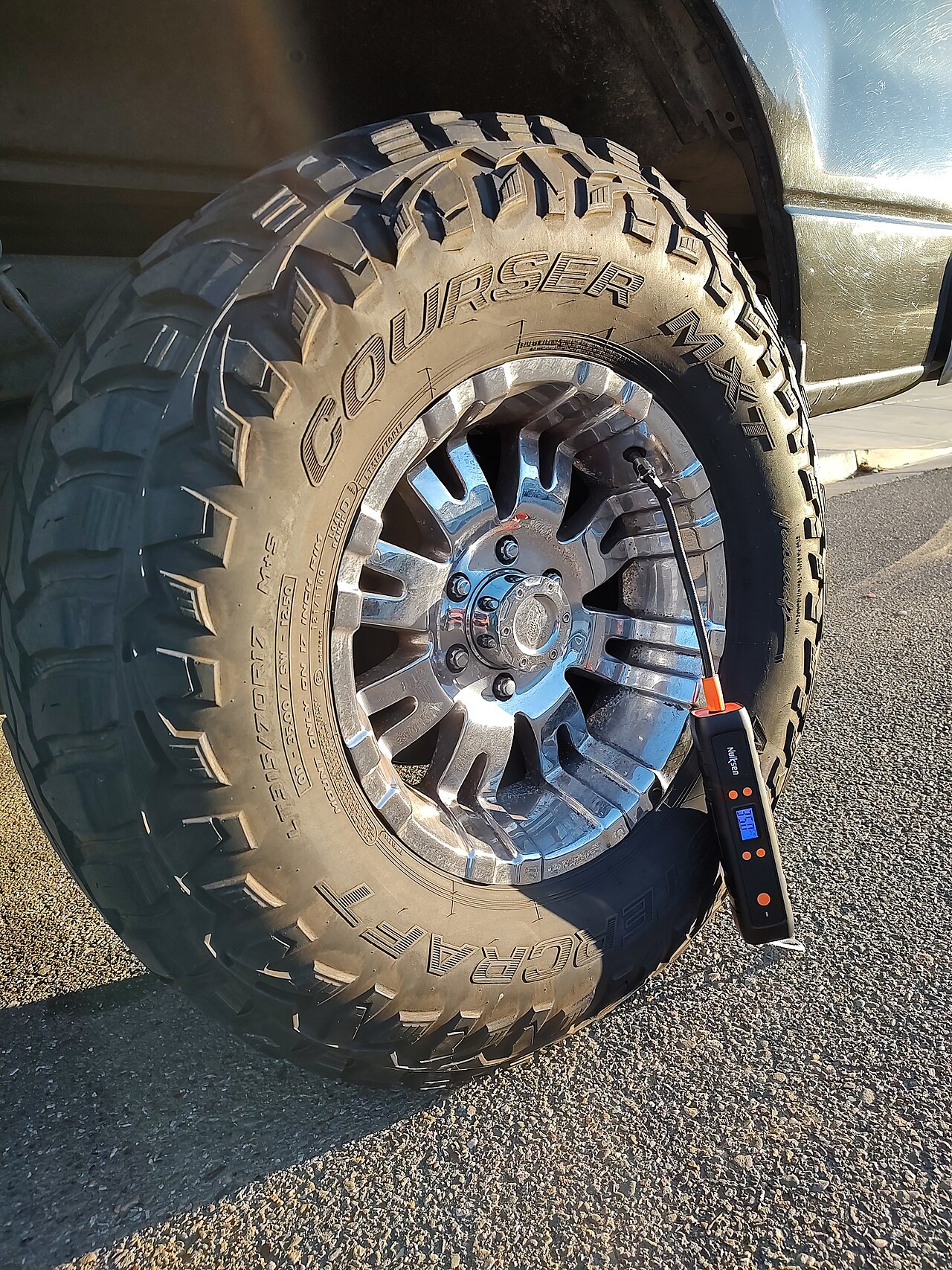
Unscrew the plastic valve cap from your tire's valve stem — keep it in your pocket, not on the ground where it rolls into a storm drain. The stem sticks out of the wheel like a short metal finger with threads on top. Inside sits a spring-loaded pin (the Schrader valve core) that holds air in until you press something against it. The pump chuck has a lever or twist collar. Flip the lever up (or twist counterclockwise) to open the jaws. Press the chuck straight onto the stem until you feel a solid metal-on-metal seat. You'll hear a sharp hiss for half a second — that's the pump pressurizing its own hose. Then the hiss stops. If it keeps hissing, the chuck isn't seated. Pull it off, check for dirt on the stem tip, and try again. Lock the lever down (or twist clockwise) to clamp it. Now the pump gauge shows your tire pressure.How do I read the gauge and know when to stop?
Two gauge types exist. Analog dial gauges have a needle sweeping across numbers — read the needle tip, not the reflection. Digital gauges flash numbers on an LCD screen. Both measure in PSI (pounds per square inch). Your target is the door-jamb number. If the gauge reads 26 and you need 32, you need 6 PSI more. Squeeze the trigger on the hose handle (or press the inflate button on digital units) in three-second bursts. Watch the gauge climb. Pause. Read. Repeat. When you hit your number, release the trigger. Wait two seconds. Read again — the gauge settles. If you overshoot by 2 PSI, press the small bleed button on the chuck side (looks like a tiny pin) to let air out. Don't guess. A tire at 38 PSI on a 32 PSI spec wears the center tread fast and rides harsh on I-95 expansion joints. The video walks through the full sequence at a typical South Florida station: payment, hose handling, chuck seating, and gauge reading. Key points to watch for: keep the chuck pressed straight on — not angled — because angling leaks air and gives false low readings. Check pressure after the pump stops, not while air is flowing, since flowing air makes the needle jump. If the video shows a bleed valve, that's the tool for letting air out if you accidentally overfill.Why does the pump gauge read different from my own gauge?
Station gauges live outside in salt air, get dropped, and rarely get calibrated. It's common for public pump gauges to read off by a few PSI. Your pencil gauge or digital gauge in the glove box — if it's decent — is usually closer to truth. Best practice: use the station pump to add air, but verify with your own gauge after. Keep a $5 digital gauge in the center console. Check all four tires, plus the spare if it's accessible. Tires lose roughly 1 PSI per month naturally, plus 1 PSI for every 10-degree temperature drop. A cold front in January can drop your pressure 5 PSI overnight. That's why the light comes on after the first cool night of the season.What if the hose won't reach all four tires?
Pull forward or back until the hose reaches. If your rear passenger tire is too far, drive forward two feet. Put the car in park, set the brake. Don't stretch the hose until it pulls the chuck off at an angle — that leaks air and damages the chuck seal. If the hose truly won't reach (some stations have short hoses), pay for another session at the next pump island, or drive to the next station. Know which stations near your house have working pumps and long hoses before you need them.When should I check pressure instead of just filling?
Check monthly. Check before any trip longer than 50 miles. Check when the TPMS light (tire pressure monitoring system) illuminates — that light means at least one tire is 25 percent below spec. On a 32 PSI tire, that's 24 PSI. You're already driving on a soft sidewall, which builds heat. Heat causes blowouts. Check after hitting a pothole on NE 12th Avenue hard enough to bend the rim. Check when the seasons shift — October and March in South Florida. The gauge in your console takes fifteen seconds per tireWhen to call us
DIY is great, but some jobs need a pro. If the problem persists, you spot anything dangerous, or you'd rather have an expert handle it, call (786) 949-9563 — North Miami Tire serves North Miami and nearby (Mon-Fri 5PM-7AM, Sat-Sun 24H). No pressure, no upsells.