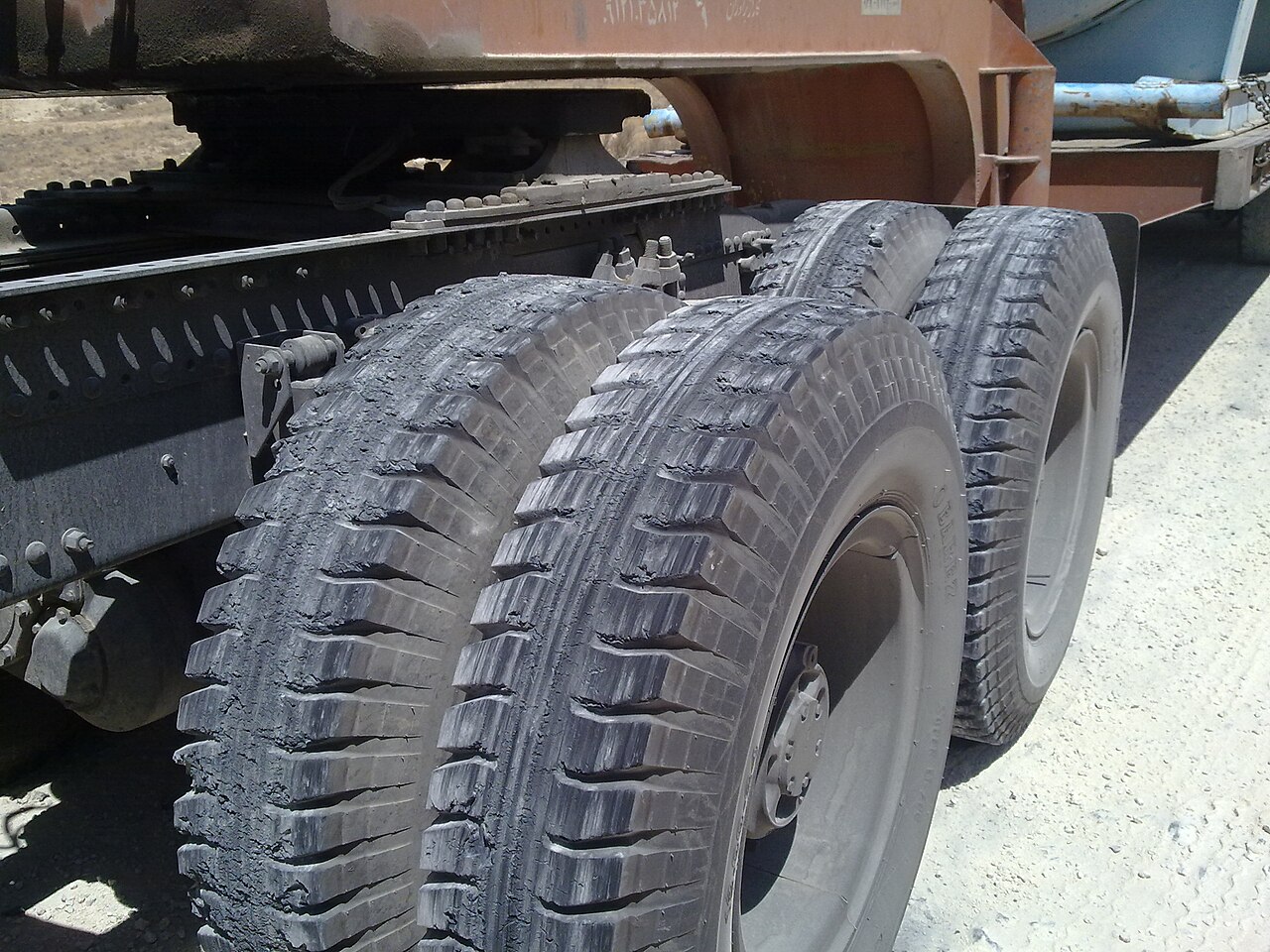
How to Read Wear Patterns (Diagnosis Chart)
Tire wear patterns reveal the root cause: center wear means overinflation, edge wear means underinflation, one-sided wear points to alignment or camber issues, cupping signals worn suspension parts, and feathering indicates toe problems. Matching the pattern to the cause lets you fix the source instead of just replacing rubber.
What does center wear tell you about tire pressure?
When the middle of the tread wears faster than the edges, the tire has been running overinflated. The extra pressure balloons the contact patch so only the center strip touches the road. You'll see a smooth, shiny stripe down the middle while the shoulders still show full tread depth. Check the placard on the driver's door jamb — not the sidewall max — and set pressure cold, first thing in the morning before driving. A tire that reads several PSI higher after a drive than it does cold is telling you the cold reading was low. That difference is enough to shift the wear pattern.Why are both edges worn but the center looks new?
That's the classic underinflation signature. Low pressure lets the sidewalls flex too much, so the shoulders carry the load while the center lifts off the pavement. You'll feel it in the steering — vague, mushy response — and see it at the pump: the tire eats gas because rolling resistance climbs. Even a few PSI below spec costs you a measurable chunk of fuel economy, and it adds up over thousands of miles. The sidewalls also run hotter, which ages the rubber faster and raises blowout risk on a July run down I-95.What causes one-sided wear on just the inside or outside edge?
Camber. If the top of the tire leans in (negative camber), the inside edge scrubs. If it leans out (positive camber), the outside edge takes the hit. A little camber is built in for cornering, but a bent control arm, worn ball joint, or sagging spring pushes it past spec. You'll often feel a pull to one side on a flat stretch of NE 123rd Street. The fix isn't a tire rotation — it's an alignment that brings camber back into the manufacturer's window, usually within half a degree of zero for most passenger cars.Why does the tread feel like a washboard when you run your hand across it?
That's cupping, also called scalloping. The tread blocks wear unevenly in a repeating high-low pattern because the tire bounces as it rolls. Worn shocks or struts are the usual suspect — they stop controlling the spring oscillation, so the tire hammers the pavement in rhythm. You'll hear a low-frequency thrum that speeds up with vehicle speed, distinct from a bearing growl. Cupping can also come from unbalanced wheels, but the bounce test at each corner (push down, release, count oscillations) separates suspension from balance. More than one and a half rebounds means the damper is done.What does feathering look like and what does it mean?
Run your fingertips across the tread blocks circumferentially. If one side of each block feels rounded and the other feels sharp — like a row of tiny ramps — that's feathering. It happens when the tires point slightly inward or outward (toe misalignment) and scrub sideways as they roll forward. Toe-out feathers the inside edges; toe-in feathers the outside edges. A sixteenth of an inch of toe error scrubs tread fast. You'll notice the steering wheel sits off-center when driving straight on a crowned road like NW 7th Avenue.Can a bad balance cause a distinct wear pattern?
Yes. A heavy spot on the wheel-tire assembly creates a once-per-revolution impact that hammers one section of tread. Over thousands of miles, that spot wears a flat patch or a series of dips spaced exactly one circumference apart. You'll feel a vibration that peaks around 55–65 mph and fades above 70. A dynamic balance with stick-on weights on the inner barrel and clip-ons on the outer flange usually clears it. If the vibration persists after a clean balance, the tire itself may have a force variation defect — rare, but it happens.How do you read a wear pattern diagnosis chart in practice?
Start with a clean tire and good light. Use a tread depth gauge at three points across the face: outside shoulder, center, inside shoulder. Write down the numbers. Compare left to right front, front to rear. A difference of 2/32 inch or more across the same axle flags a problem. Next, feel for feathering and cupping with your fingertips. Note which edge, which axle, which side. Then match the pattern to the cause: center wear → pressure; edge wear → pressure; one-sided → camber; feathering → toe; cupping → suspension or balance; patch wear → balance or defect. The chart is a map — the measurements are your coordinates.Here's a video that shows how to spot misalignment from the driver's seat — including checking your tires for the uneven wear clues covered above:
The video walks through how to physically tell a car is misaligned from the driver's seat — drift on a straight road, a crooked steering wheel, and checking your tires for one edge worn more than the other or a feathered feeling across the tread. It pairs well with this guide: the article shows you how to read the pattern, the video shows you how to notice the symptoms on the road.When to call us
DIY is great, but some jobs need a pro. If the problem persists, you spot anything dangerous, or you'd rather have an expert handle it, call (786) 949-9563 — North Miami Tire serves North Miami and nearby (Mon-Fri 5PM-7AM, Sat-Sun 24H). No pressure, no upsells.