How to Inspect Tread (Penny Test)
What does the penny test actually measure?
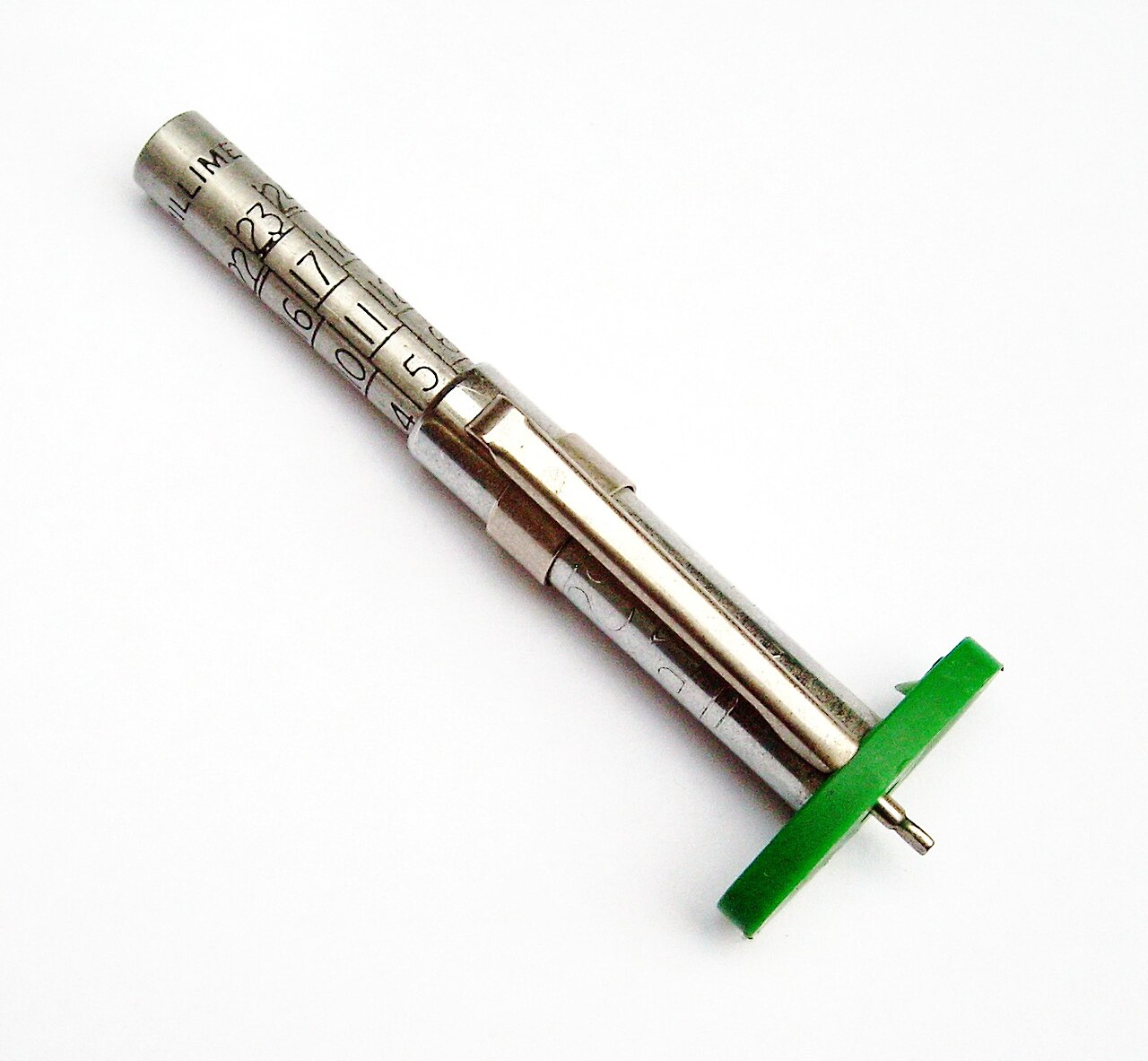
Tread depth is the distance from the top of the tread block to the bottom of the groove. New passenger tires start around 10/32" to 11/32". The legal limit in Florida — and most states — is 2/32". That's the thickness of two credit cards stacked together. Below that, water can't escape fast enough from under the contact patch. The tire rides on a film of water instead of gripping the road. That's hydroplaning. The penny works because the distance from the edge of the coin to the top of Lincoln's head is almost exactly 2/32". It's a go/no-go gauge you already have in the cupholder. A tread depth gauge gives you the exact number in 32nds of an inch. The penny tells you pass or fail. Both have a place.How do I do the penny test step by step?
Grab a penny. Clean the tread grooves with your thumb if they're packed with sand or small stones — common after driving on Collins Avenue near the beach. Insert the penny head-first into the deepest part of a groove. Look at Lincoln's head from eye level. If the entire head is visible, that groove is at or below 2/32". If the forehead is covered, you're above the legal minimum. Repeat in three grooves across the tire: outside shoulder, center, inside shoulder. Do this on all four tires. Write down which grooves pass and which fail. A tire that passes on the outside but fails in the center usually means overinflation. A tire that fails on both shoulders but passes in the center usually means underinflation. One tire failing while the others pass could mean a suspension issue on that corner.What do the different tread wear patterns mean?
Center wear — the middle ribs are smooth while the shoulders still have grooves — means the tire ran overinflated. The contact patch shrinks to a narrow strip down the middle. You'll feel a harsher ride and see faster wear in that strip. Shoulder wear — both edges worn down while the center looks new — means underinflation. The sidewalls flex too much, heat builds up, and the shoulders scrub away. This is the most dangerous pattern because the tire can overheat and blow out at highway speeds on I-95. One-sided wear — just the inside or just the outside shoulder worn — points to alignment. Negative camber eats the inside shoulder. Positive camber eats the outside. Toe misalignment feathers the edges so they feel sharp in one direction and smooth in the other. Run your hand across the tread blocks. If they feel like saw teeth, the alignment is off. Cupping — scalloped dips around the circumference — usually means worn shocks or struts. The tire bounces and lands on the same spots repeatedly.When is the penny test not enough?
The penny test only checks depth. It doesn't see cracks in the sidewall from sun exposure — common on cars parked outside in North Miami year-round. It doesn't show bulges from impact damage after hitting a pothole on NW 7th Avenue. It doesn't reveal dry rot, where the rubber turns gray and brittle. It doesn't measure tire age. The DOT code on the sidewall ends with four digits: week and year of manufacture. Tires older than six years should be inspected by a pro regardless of tread depth. The penny also can't detect internal belt separation, which shows up as a vibration that gets worse with speed. If you see cords or steel belts showing through the rubber, the tire is past done. Don't drive on it. If the tread is uneven but still above 2/32" in the deepest groove, the penny says pass — but the tire may still need replacement because the worn section can't evacuate water.How often should I check my tread depth?
Once a month. Same day you check pressure. Takes two minutes. Keep a penny in the glovebox. Check before long trips — especially heading to the Keys or up I-75 where a blowout leaves you stranded with no shoulder. Check after hitting debris or a hard pothole. Check when the seasons shift. Hot pavement accelerates wear. Cold mornings drop pressure, which changes the contact patch and wear pattern. The wear bars — raised strips molded into the bottom of the grooves — become flush with the tread at 2/32". When you see a solid bar connecting across the groove, the tire is at the legal limit. That's your backup visual check if you lose the penny. Watch this quick walkthrough of the penny test and what the wear patterns look like on real tires:The video below covers what good tread depth actually looks like and how to measure it. It walks through the penny test and explains what the reading means -- how deep the tread should be on a healthy tire versus the 2/32-inch minimum where replacement becomes urgent. The host shows how to take the measurement in the groove and what a worn tire looks like next to one with life left. It pairs well with the wear-pattern section above: once the penny tells you a tire is thin, the pattern across the tread tells you why.
When to call us
If the penny test fails on any groove, or you spot cracks, bulges, or uneven wear the coin cannot explain, do not wait for the next rainstorm.
DIY is great, but some jobs need a pro. If the problem persists, you spot anything dangerous, or you'd rather have an expert handle it, call (786) 949-9563 — North Miami Tire serves North Miami and nearby (Mon-Fri 5PM-7AM, Sat-Sun 24H). No pressure, no upsells.